
Global investing becomes much easier to understand when you stop looking for a single “best market” and start separating the forces that actually drive returns: economic growth, capital flows, currency, liquidity, valuation, structural investment and the role each asset plays inside a portfolio.
That distinction matters in 2026 because the macro picture is not giving investors one clean message. Growth remains positive, but major institutions are publishing different estimates. Foreign direct investment has recovered, but it is concentrated. Energy and digital infrastructure are absorbing enormous amounts of capital. Reserve currencies remain dominated by the US dollar, yet cross-border investors increasingly think about currency exposure as a separate layer of risk rather than an afterthought.
This guide is not a forecast of which country or asset will outperform next. It is a process for reading the global investment environment with more structure. The objective is to move from headline to framework: what is changing, why it matters, what risks sit underneath it and how an investor can test an opportunity before committing capital.
1. Start with the regime, not the ticker
The first mistake in global investing is to begin with an asset before understanding the environment around it. A stock, bond, property or private deal does not operate in isolation. It sits inside a regime shaped by growth, inflation, interest rates, credit conditions, trade, fiscal policy and geopolitics.
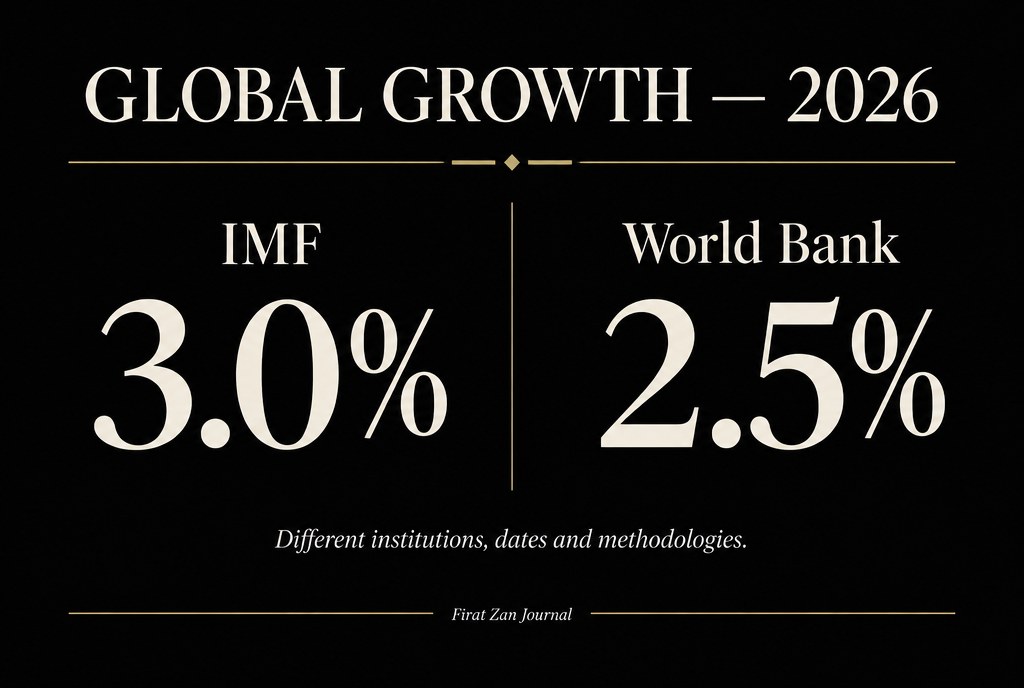
In July 2026, the IMF projected global growth of 3.0% for 2026 and 3.4% for 2027. The World Bank’s June 2026 forecast was more cautious at 2.5% for 2026. IMF source · World Bank source. Those numbers should not be treated as a contradiction that requires choosing one institution over the other. They reflect different assumptions, publication dates and methodologies. The useful signal is the range: the world economy is still expanding, but the path is uneven and sensitive to conflict, financing conditions and technology investment.
For an investor, the practical question is not “which forecast is right?” It is “what does this range imply for the asset I am considering?” A highly leveraged investment may be more sensitive to weak growth and high financing costs than an asset with low debt and strong recurring cash flow. A company tied to AI infrastructure may behave differently from a consumer business exposed to weak household demand. The same macro environment can create very different outcomes across sectors.
2. Follow where capital is actually moving
One of the most useful ways to read the global economy is to look at foreign direct investment. FDI is not the same as short-term portfolio flows: it often reflects longer-duration commitments to factories, infrastructure, data centres, logistics, energy projects and operating businesses.
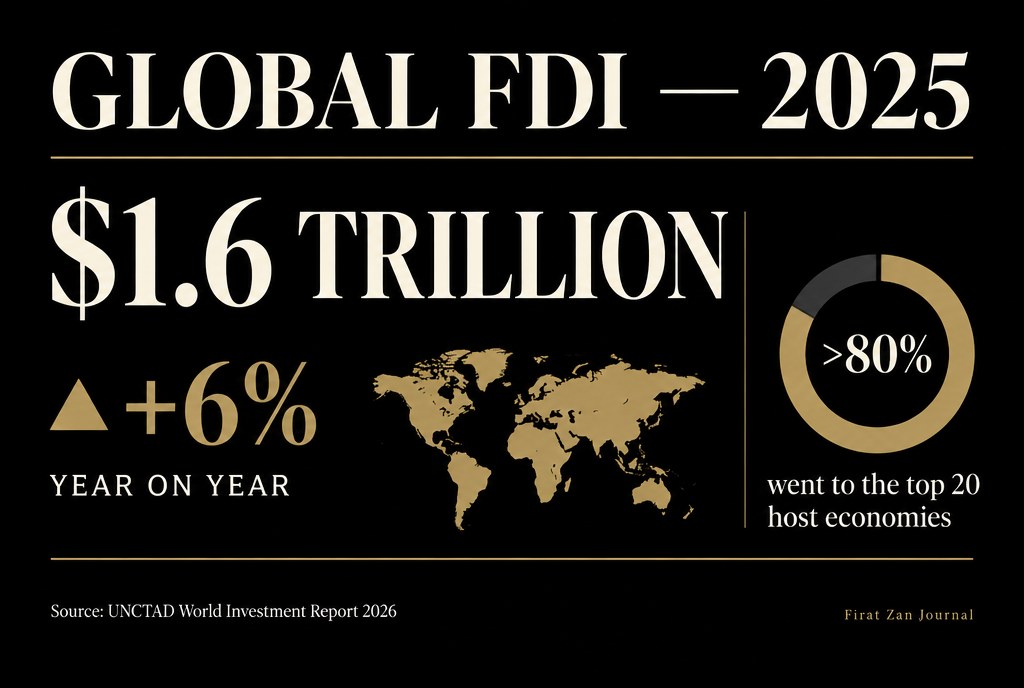
UNCTAD reported that global FDI rose 6% to $1.6 trillion in 2025 after two years of decline. UNCTAD source. But the more important detail is concentration. More than 80% of global FDI went to the top 20 host economies, while strategic sectors accounted for a much larger share of global greenfield investment value than they did earlier in the decade.
That concentration changes how I think about the phrase “emerging opportunity.” A market can have strong demographics and still struggle to attract investment if legal clarity, infrastructure, financing or exit liquidity are weak. Conversely, a mature economy can continue attracting capital because it combines deep markets, technology ecosystems, power supply, rule of law and institutional buyers.
The investor’s job is therefore to distinguish between a compelling narrative and an investable environment. A country story may sound attractive, but the real questions are whether capital can enter, operate, earn and eventually exit under reasonable conditions.
3. Structural investment can matter more than the economic cycle
Not all investment themes depend on the same economic cycle. Some are driven by multi-year infrastructure requirements that continue even when consumer demand slows. Energy is a good example.
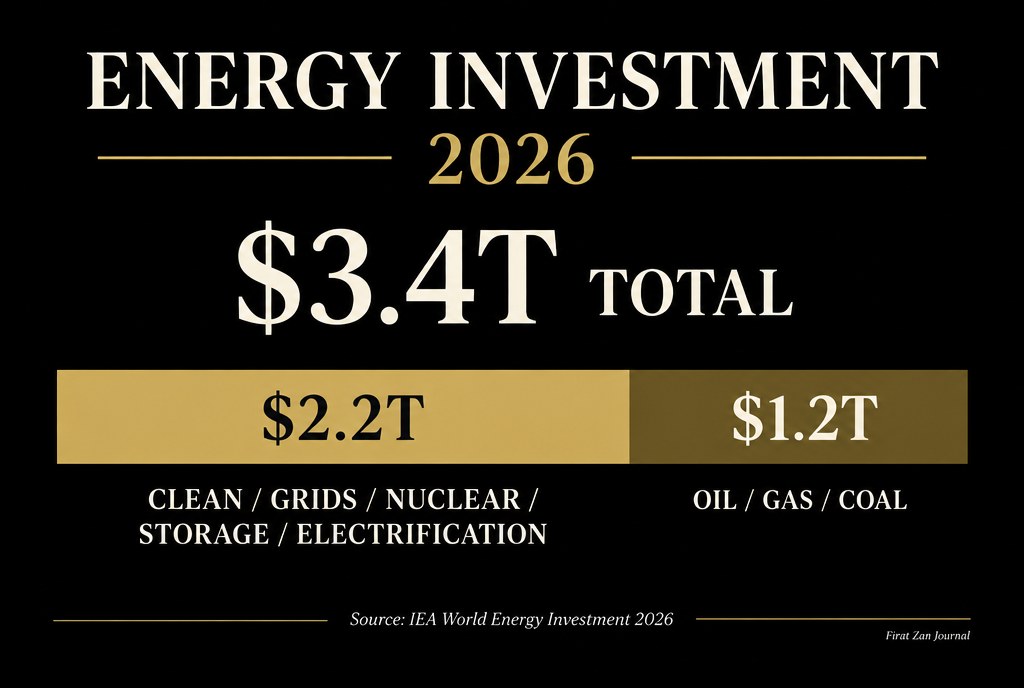
The IEA expects global energy investment to reach a record $3.4 trillion in 2026. IEA source. Around $2.2 trillion is expected to go to renewables, nuclear, grids, storage, low-emissions fuels, efficiency and electrification, while roughly $1.2 trillion is expected to flow into oil, natural gas and coal. The report also highlights the growing importance of energy security and electricity infrastructure.
For investors, a structural theme becomes more useful when it is translated into the real assets and businesses required to support it. AI, for example, is not only a software story. It also creates demand for data centres, semiconductors, grids, generation, cooling, fibre, land, specialised construction and financing. Electrification is not only about renewable generation; it also depends on networks, storage and system resilience.
But a powerful theme is not automatically a good investment. Valuation still matters. Capacity constraints still matter. Regulation still matters. A sector can have extraordinary long-term demand and still deliver poor investor returns if entry prices assume perfection.
4. Treat currency as its own investment layer
Cross-border investing creates a second return stream that is often underestimated: currency. An asset can perform well in local terms while producing a weak result when translated back into the investor’s base currency. The reverse can also happen.
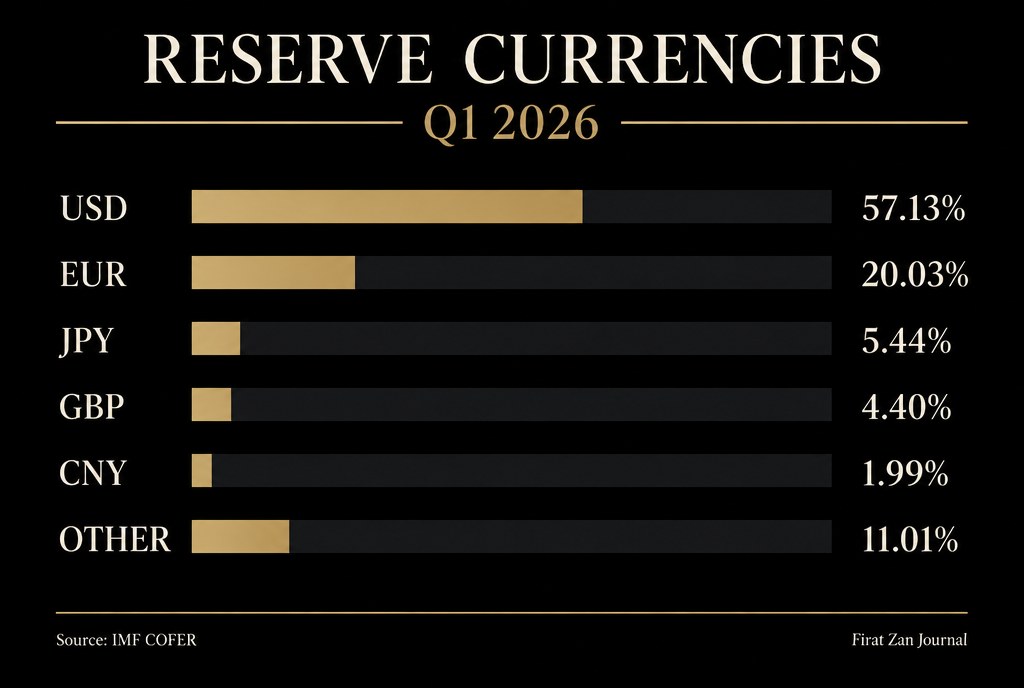
IMF COFER data for the first quarter of 2026 show the US dollar at 57.13% of allocated official foreign-exchange reserves, the euro at 20.03%, the Japanese yen at 5.44%, sterling at 4.40% and the Chinese renminbi at 1.99%. IMF COFER source. The remaining share sits in other currencies. The dollar therefore remains the dominant reserve currency by a wide margin, even as the reserve system has become more diversified over time.
I separate four currency questions: the currency used to buy the asset, the currency in which it earns income, the currency of any debt and the currency in which I ultimately want to spend or reinvest the proceeds. If those four are different, the position has more moving parts than its headline yield suggests.
This is especially important in property and private investments because the asset itself may be illiquid. Currency can move immediately while the underlying position may take months or years to exit. That mismatch should be understood before the investment is made, not discovered during a period of stress.
5. Give every part of the portfolio a job
A portfolio becomes easier to manage when positions are organised by purpose instead of by logo, country or story. I like thinking in five roles: liquidity, income, growth, protection and optionality.
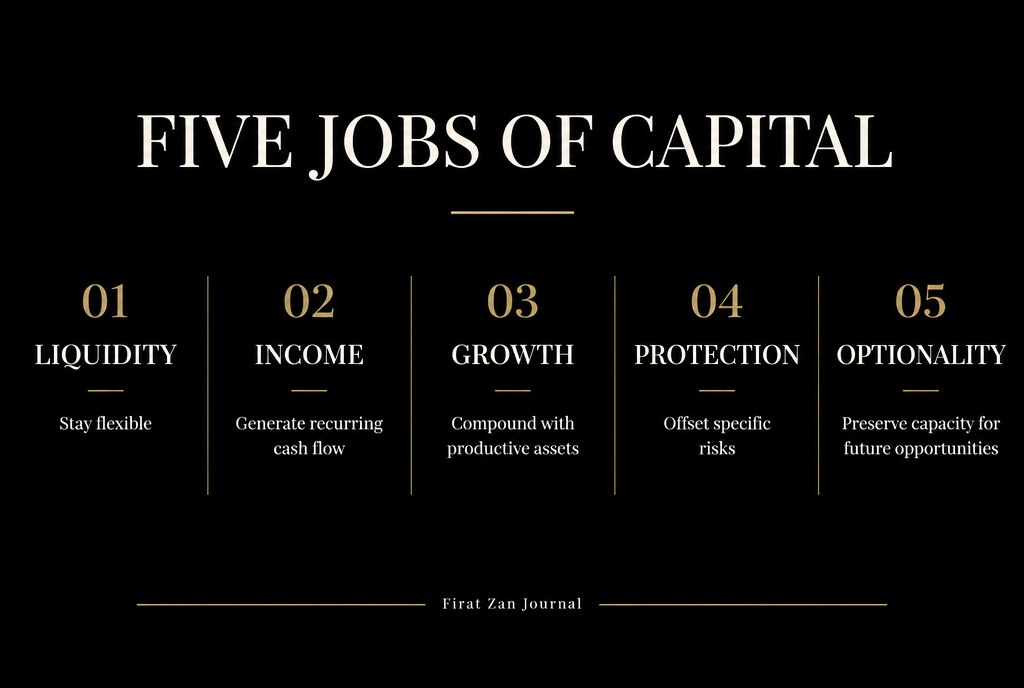
This approach prevents a common mistake: expecting one asset to do everything. Property can create income and collateral but may be slow to sell. Equities can offer liquidity and growth but can reprice sharply. Cash can reduce pressure but may lose purchasing power. Private deals can create asymmetric upside but often require patience. Each strength comes with a trade-off.
6. Cross-border investing requires a second level of due diligence
Domestic investing already requires analysis. Cross-border investing adds currency, legal systems, tax, ownership rules, financing structures and different exit markets. That means a strong asset can still become a weak investment if the surrounding structure is poorly understood.
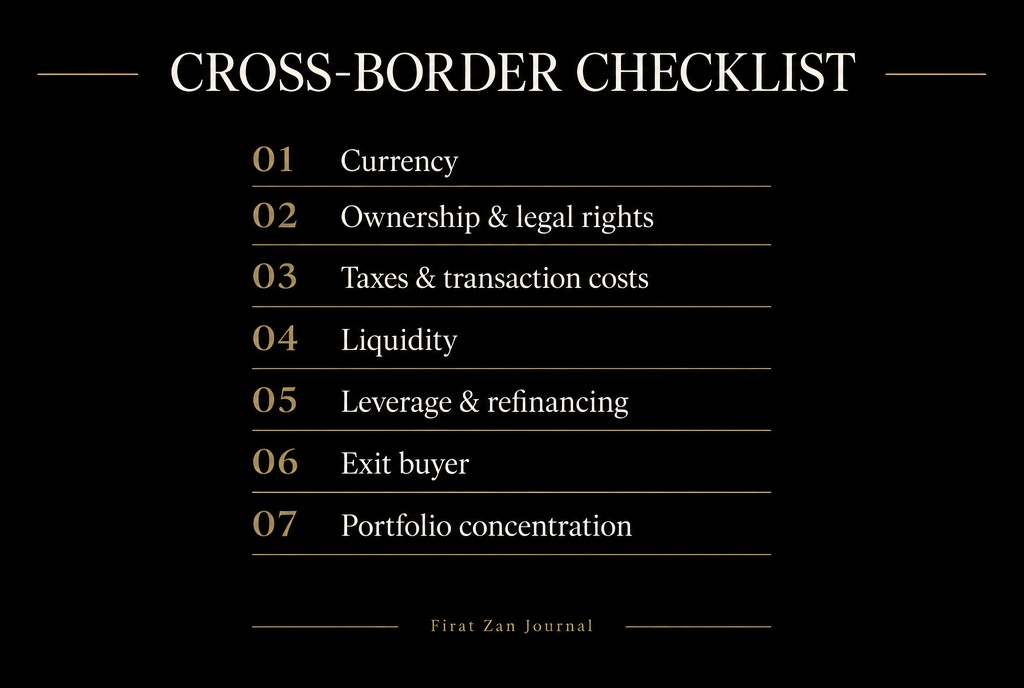
Ownership rights should be clear. Transaction costs should be modelled before purchase, not after. Financing should be tested against higher rates or weaker income. The exit buyer should be identifiable. If a property can only be sold to another international investor under perfect market conditions, that is a different risk profile from an asset with broad local demand.
Concentration is equally important. Buying assets in three countries does not create meaningful diversification if all three depend on the same source of foreign demand, the same commodity cycle or the same currency. Geography can look diversified while the underlying economic driver remains identical.
7. Liquidity and valuation decide whether a good story becomes a good investment
Two questions cut through almost every investment narrative: how much am I paying, and how easily can I change my mind?
Valuation determines how much future success is already reflected in the price. A strong business can be a weak investment at an extreme price. A desirable city can produce disappointing property returns if supply expands faster than demand. A strategic sector can attract record capital and still create poor returns if competition destroys margins.
Liquidity determines the investor’s ability to respond. A listed asset may be sold within seconds. A private company stake may require years. A property may need months and a price reduction. That difference matters because opportunity cost is real. Capital locked in one position cannot be redeployed into another without an exit.
For that reason, I do not think of cash and liquid instruments as “doing nothing.” Their job is flexibility. In uncertain environments, flexibility can improve negotiating power and reduce the risk of forced decisions.
8. Build a decision process that survives changing headlines
The most useful investment process is one that can still be applied when the narrative changes. A framework should begin with the macro regime, move to the role of the asset, identify currency exposure, test valuation and liquidity, and finish with a realistic exit.
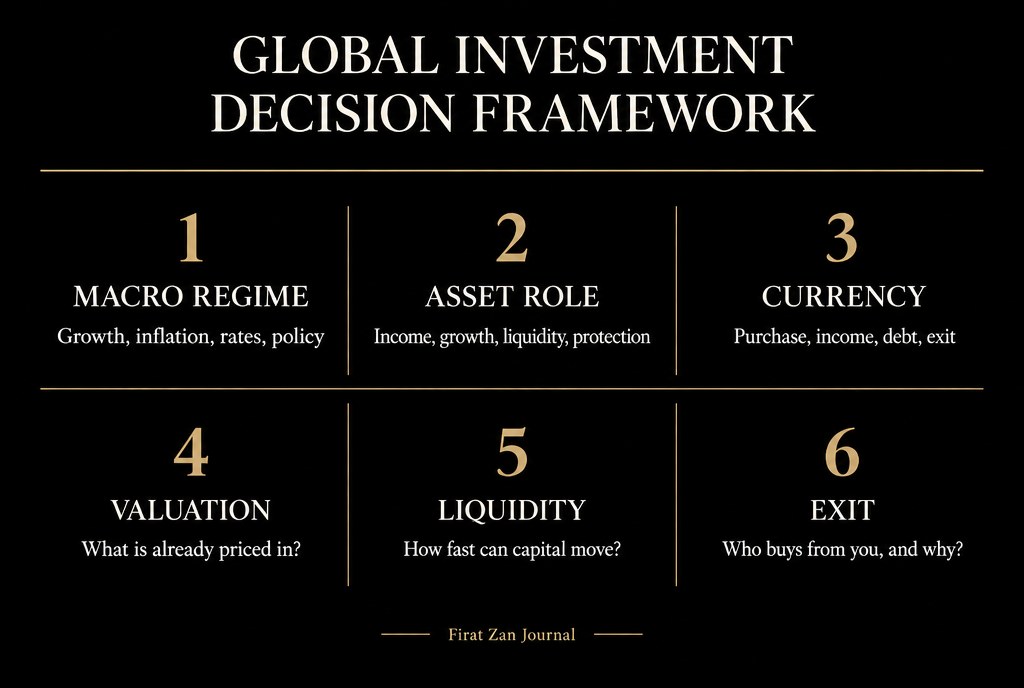
This sequence reduces the temptation to start with excitement and invent the justification afterwards. It also makes different asset classes easier to compare. A rental property, an equity position and a private business cannot be compared only by expected return because their liquidity, leverage, control, volatility and time horizon are fundamentally different.
When I evaluate a global opportunity, I want to know what has to go right, what can go wrong, how long capital may be locked, what currency risk exists and who is likely to buy the asset from me later. If those answers are unclear, the opportunity is not yet fully understood.
9. What the 2026 data are really saying
The macro numbers point to a world that is still investing, but doing so more selectively. Growth is positive but uneven. FDI has rebounded but is concentrated. Energy investment is at record levels. Technology and electrification are increasing the importance of infrastructure. The dollar remains central to the reserve system. At the same time, financing costs, geopolitical risk and fragmentation remain meaningful constraints.
That combination favours discipline over prediction. It rewards investors who understand the role of liquidity, who separate asset risk from currency risk and who are willing to reject a good story when valuation or exit conditions are poor.
10. Final framework
Global investing in 2026 is not about collecting countries on a map. It is about identifying independent economic drivers and understanding the structure around each investment. Growth matters, but so do financing conditions. Capital flows matter, but concentration matters too. Structural themes matter, but price determines whether the investor captures the benefit. Currency matters because the asset and the investor may live in different monetary systems.
The best use of global data is therefore not prediction. It is preparation. A disciplined investor can use macro information to ask better questions, define portfolio roles, compare opportunities on the same framework and preserve enough liquidity to act when conditions change.
That is the advantage of a process: the headlines will keep changing, but the questions do not have to.