
Should you pay off debt or invest the money instead? The answer depends on the cost of the debt, the reliability of your income, the cash you can access and the risk you would take to earn an investment return.
Someone carrying an expensive credit-card balance faces a different decision from someone with a manageable fixed-rate mortgage. Treating those situations as identical produces advice that sounds simple but can make a financial plan fragile. A good comparison starts with the actual obligations and the purpose of the money.
This guide builds that comparison step by step. It explains how to read borrowing costs, compare them with investment returns, protect emergency savings and decide when a combined approach deserves consideration. The examples are hypothetical and use dollars for clarity; the framework can be applied in another currency when all inputs use the same basis.
1. Start with the debt you actually have
Write down each balance, interest rate, required payment and due date. Add whether the rate is fixed or variable, when a promotional offer ends and whether extra payments trigger a charge. Record the currency of the liability as well. A loan denominated in one currency and paid from income in another can introduce an additional risk.
The monthly payment alone is an incomplete measure of borrowing cost. A smaller payment can come from a longer term, leaving the borrower paying interest for more years. A low introductory rate can be followed by a much higher rate later. A refinancing offer can reduce the quoted interest rate while adding arrangement fees or extending the repayment schedule.
APR can help compare borrowing costs, but definitions and included charges differ by product and jurisdiction. Check the agreement for the interest calculation, recurring fees and early-repayment treatment. When a fee is unavoidable whether or not you make an extra payment, do not count it as a saving from that payment.
Consider a hypothetical $10,000 balance at 18% annual interest. If the balance stayed at $10,000 for a full year and interest were paid as it accrued, the interest cost would be approximately $1,800. An amortizing balance would generate a different total because principal changes through the year. The example isolates the cost of carrying a constant balance; it is not a payoff quote.
That difference matters when estimating the benefit of a partial repayment. Reducing principal lowers future interest on the amount repaid, but the exact saving depends on timing and contract terms. The useful starting point is the lender's current repayment schedule or a quote showing how an extra payment changes principal, future interest and maturity.
2. Compare a borrowing cost with a net investment return
Paying down debt removes some future interest expense. Investing creates exposure to a future outcome that can be positive or negative. These are different kinds of financial results, even when both can be expressed as a percentage. A projected market return is not equivalent to an interest charge that the borrower must pay.
Investor.gov emphasizes eliminating high-interest borrowing, including prioritizing the highest-rate balance while maintaining required payments on the others. That guidance supports the basic distinction: costly debt is difficult to justify against uncertain investment gains.
In the constant-balance illustration above, eliminating $10,000 of 18% debt avoids approximately $1,800 of annual interest. Investing $10,000 at a hypothetical 6% annual return would generate $600 before fees and taxes if that return occurred. Investing does not remove the debt, and a disappointing investment year would leave the borrowing obligation in place.
When people describe repayment as earning a return equal to the interest rate, they mean an avoided cost. It is not investment income deposited into an account. The comparison is most direct for debt without an interest deduction, prepayment charge or changing rate. Those features need separate treatment rather than being hidden inside the shortcut.
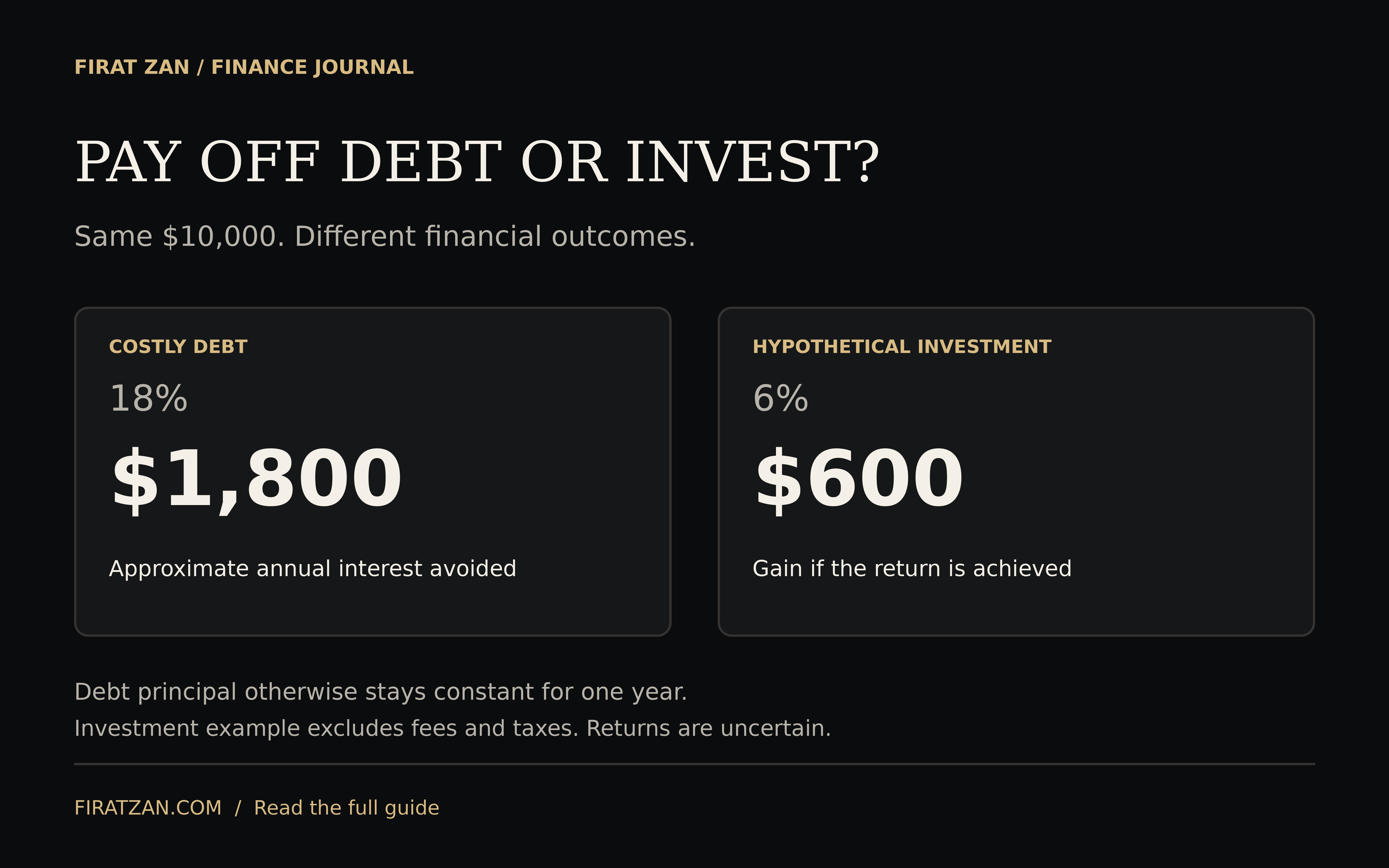
| Use of money | Assumption | Financial effect |
|---|---|---|
| Repay expensive debt | 18% interest; principal otherwise constant | About $1,800 of avoided interest |
| Invest | 6% return, if achieved | $600 before fees and taxes |
| Hold accessible savings | Return depends on the account | Liquidity for emergencies and bills |
A lower-cost loan makes the comparison less obvious. Suppose debt costs 4%, with no deduction or repayment penalty. A hypothetical investment earns 5% before a fee equal to 0.5% of starting capital. If a hypothetical 20% tax then applies to the remaining 4.5% gain, the retained return is 3.6%. Under those particular assumptions, the headline 5% has become less than the debt's 4% cost.
Actual fees and taxes can have different calculation bases and dates. Investment gains can be deferred, exempt, taxed differently or not realized at all. The example shows why inputs matter; it does not establish the tax treatment of any account or country. My guide to investment returns versus inflation explains how to keep gross, net and real performance distinct.
A rough tax-only hurdle can also reveal a mismatch. If a fully taxable gain loses 20% to tax, earning 18% after tax would require 22.5% before tax: 18% divided by 0.80. This deliberately simplified illustration ignores fees, loss treatment and tax timing. It should prompt a closer review of expensive borrowing, not a search for investments promising an unusually high return.
3. Repayment should leave the plan able to handle surprises
A person can reduce debt aggressively and still leave themselves vulnerable if every spare dollar goes to principal. An unexpected repair, interrupted income or medical expense can then create a new balance. The first debt was reduced, but the household never gained a dependable buffer.
Investor.gov describes emergency savings as accessible money for unexpected needs. Accessibility matters: money invested in volatile assets may be worth less when an emergency arrives, while money locked in an asset may be unavailable without delay or cost.
Estimate essential monthly spending rather than selecting an emergency-fund amount because it looks impressive. Essential spending includes housing, food, utilities, insurance, necessary transport and required debt payments. Then consider income stability, dependants, available insurance and the time it could take to replace lost earnings.
If essential costs are $3,000 per month, a $3,000 reserve covers roughly one month and a $9,000 reserve roughly three months. Those figures are arithmetic examples, not a universal instruction. A freelancer with uneven income can need a different buffer from a household with two dependable incomes. A reserve should also be separate from money already committed to next month's rent.
Do not treat a credit limit as identical to cash. The lender can change access or terms, and using the limit introduces another repayment obligation. Accessible savings create flexibility without relying on a new borrowing decision. This connects directly with the distinction between cash flow and net worth: a valuable asset does not automatically fund a bill due tomorrow.
4. An employer match deserves its own calculation
Some workplace savings arrangements add an employer contribution when an employee contributes. Where that benefit exists, compare it with the debt decision separately. It can be economically meaningful, but the actual rules determine how much of the benefit the employee can keep and when the money can be used.
For example, suppose a plan adds $500 for an eligible $1,000 employee contribution. The account initially receives $1,500 before investment changes and applicable taxes or charges. The employer addition equals 50% of the employee contribution. That is a contribution benefit, not a recurring annual investment return or a prediction of future account growth.
Check eligibility, contribution limits, vesting, access restrictions and the investment options. An unvested benefit that could be lost after a job change should not be treated as certain personal capital. Money subject to withdrawal restrictions cannot replace an emergency reserve simply because the statement shows a higher balance.
This comparison also has limits. Falling behind on essential bills or required debt payments to obtain a match can create costs and consequences elsewhere. The question is whether the contribution fits within a solvent, workable budget. When plan conditions or tax consequences are unclear, obtain the scheme documents and qualified local guidance before treating the match as decisive.
5. Debt avalanche or debt snowball: choose deliberately
After required payments and essential costs are covered, a repayment method gives extra money a clear destination. The Consumer Financial Protection Bureau distinguishes the highest-interest-rate method from the snowball method. One targets the most expensive balance; the other starts with the smallest balance to produce an earlier completed repayment.
Consider three hypothetical debts: $1,800 at 24%, $5,000 at 12% and $600 at 9%. Under the avalanche method, extra payments go to the 24% balance first, while required payments continue on the others. Under the snowball method, extra payments go to the $600 balance first. The two approaches use different definitions of progress.

| Method | First extra-payment target | Reason |
|---|---|---|
| Debt avalanche | $1,800 balance at 24% | Targets the highest rate |
| Debt snowball | $600 balance at 9% | Completes the smallest balance first |
When rates, total payments and other conditions are comparable, directing extra principal to the highest rate tends to reduce interest cost. But a plan that is abandoned can perform worse in practice than one maintained consistently. The snowball tradeoff is therefore a behavioral choice with a potential financial cost, rather than a claim that smaller debts are always more expensive.
Before applying either method, identify urgent obligations. Arrears that threaten housing, essential services or other serious consequences can need attention before an ordinary unsecured balance. Contractual minimums still matter. A tidy spreadsheet should not obscure the practical consequences of missing a payment.
Once a debt is cleared, decide where its freed monthly payment goes. Automatically moving it to the next target preserves momentum. Letting it disappear into additional spending can slow the overall plan even though one account now shows zero. A payoff milestone is most useful when it changes the structure of the next month.
6. A mortgage is a separate, less liquid decision
A mortgage can have a longer term and a lower rate than unsecured borrowing, but that does not make early repayment automatically beneficial or automatically wasteful. Compare the remaining rate period, refinancing exposure, prepayment conditions, interest treatment and the household's need for accessible capital.
Extra mortgage principal increases equity in the property. Accessing that value later can require a sale or new borrowing, with eligibility checks, costs and uncertainty. A household should distinguish a stronger property balance sheet from a larger cash reserve. The two can support different needs.
Check how the lender applies an additional payment. In some arrangements it reduces the term while the required payment stays unchanged. In others, a payment reduction may require a formal recalculation. Paying extra does not necessarily create an immediate improvement in monthly cash flow, even though it reduces future interest.
Variable-rate debt adds another consideration. A comparison that appears comfortable today may change after a rate reset. Test the payment against plausible higher-rate scenarios and ask whether the budget still works. A plan that depends on refinancing at attractive terms later carries an assumption that deserves to be written down.
7. Build a repayment-and-investing plan from actual surplus
Monthly surplus is the income left after essential spending, required payments and provision for predictable irregular expenses. Annual insurance, repairs and tax bills should not be treated as emergencies simply because they do not arrive monthly. Set aside for them before claiming that all remaining cash is available to invest.
Suppose a household has $750 of genuine monthly surplus after those items and has already established an appropriate accessible reserve. It could direct the full amount to an expensive balance. A household with lower-cost debt might consider splitting that surplus between repayment and long-term investing. An illustrative $600/$150 split demonstrates the mechanics; it is not a recommended allocation.
The reason for a split should be explicit. It might reflect a workplace benefit, a wish to maintain a small investing habit or a deliberate balance between lower borrowing costs and long-term growth. It should not be a compromise chosen simply because making a decision feels uncomfortable.
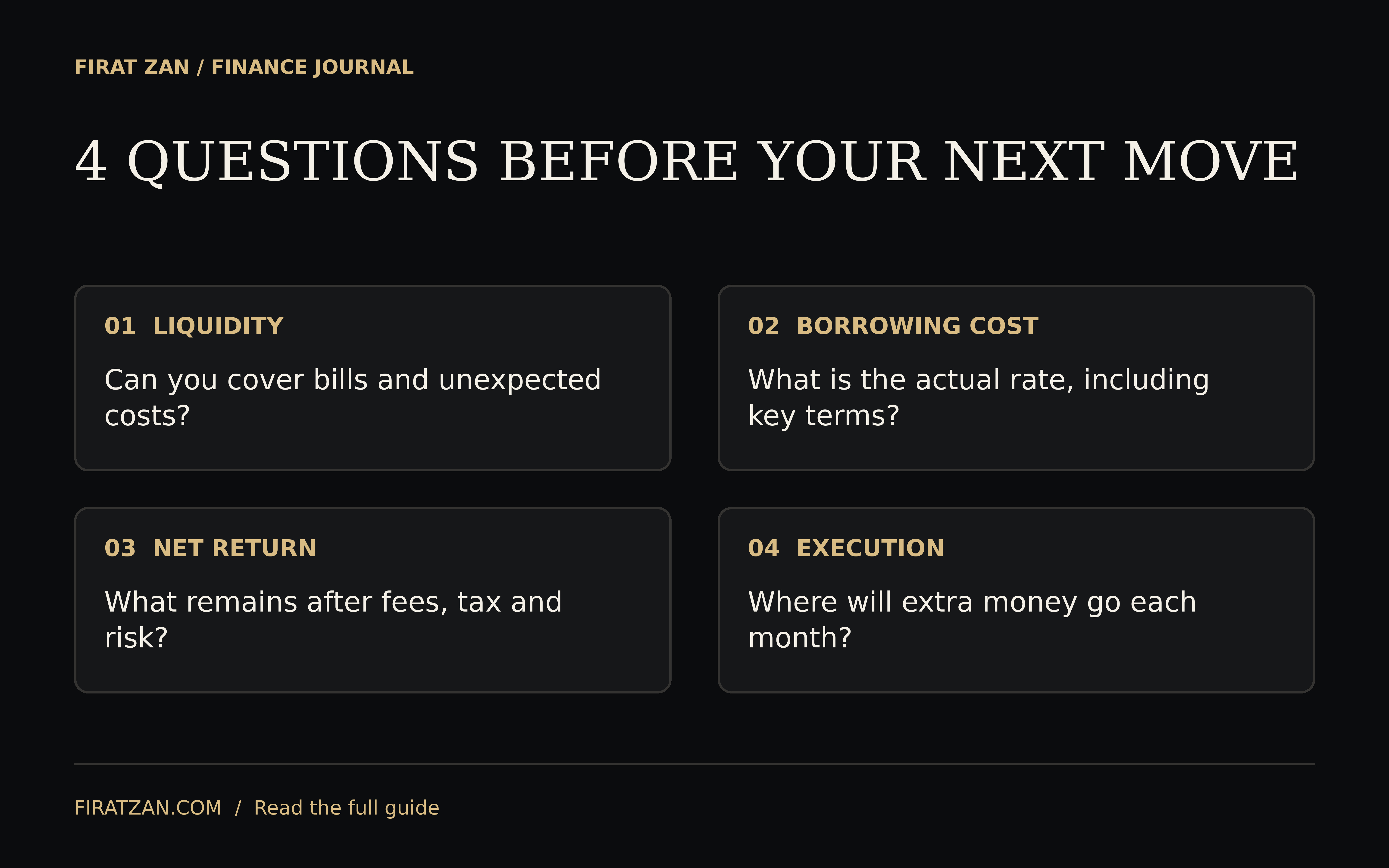
Review the plan when material inputs change: income, dependants, debt rates, a major expense or employment benefits. A monthly execution check can be brief. A full reassessment is more useful after a meaningful change than after every market headline. Consistency works best when the underlying assumptions remain visible.
8. Avoid comparisons that quietly change the rules
Do not compare a certain borrowing cost with a gross historical investment return and assume the difference will be earned. Historical results are not a repayment schedule. Fees, tax, market losses and the timing of cash needs all affect what an investment can contribute to the plan.
Do not assume that inflation makes every debt worth keeping. Inflation can reduce the real burden of fixed nominal debt only in a broader context that includes income and affordability. A household whose earnings fail to keep pace with costs can feel more pressure even while the real value of a liability changes.
Do not use money needed soon to justify a long investment horizon on paper. A portfolio intended for retirement and cash needed for a property completion have different jobs. For investors balancing assets across countries, the currency of the obligation and the ability to move funds also belong in the decision.
Finally, avoid turning the choice into an identity. Being an investor does not require keeping expensive debt. Being debt-conscious does not require postponing every long-term saving opportunity. The useful outcome is a plan whose obligations, liquidity and risks fit together.
Frequently asked questions
Is it better to pay off debt or invest?
High-interest debt often deserves priority, while lower-cost debt needs a comparison that includes liquidity, net investment returns and risk. Keep essential bills and required payments covered, and examine any employer contribution separately. There is no percentage that resolves every situation.
Should I invest while paying off credit-card debt?
Compare the card's actual cost with an uncertain net investment return. Expensive revolving debt can outweigh plausible investment gains, and keeping it while investing exposes the budget to both borrowing costs and market losses. Workplace benefits and urgent cash needs still require their own review.
Should I use all my savings to repay debt?
Check what would remain for essential expenses and unexpected needs. A repayment that leaves no accessible buffer can lead to new borrowing. The decision should consider interest savings and the household's ability to stay out of debt afterward.
Is the debt avalanche always the best method?
It focuses extra money on the highest rate and generally reduces interest cost under comparable conditions. The snowball method may be easier for some people to maintain. Required payments, urgent arrears and contract terms come before either simplified ranking.
Does paying extra on a mortgage lower the monthly payment?
Not necessarily. It can reduce the balance or shorten the remaining term without changing the required monthly payment. Ask the lender how principal payments are applied and whether a formal recalculation is needed to change the payment.
All amounts, rates and allocations in the examples are hypothetical. They illustrate comparisons rather than predict investment outcomes or describe a specific tax system. Educational analysis by Firat Zan; individual decisions depend on the applicable contract and personal circumstances.
Concept references: Investor.gov: high-interest debt; Investor.gov: emergency savings; CFPB: debt repayment methods; Investor.gov: understanding investment fees.