
A rental listing can make a property look easy to compare: a purchase price, an annual rent and a yield. An investment decision requires a longer calculation. The owner needs to understand how much capital is committed, how much income can be collected, what must be paid to keep the asset operating and what remains when the property is sold.
The rent is one part of the return. The ownership structure determines how much of it reaches you.
1. Gross rental yield is a starting point
Gross rental yield compares scheduled annual rent with the property purchase price. A property bought for $250,000 and advertised at $20,000 annual rent has an 8% gross yield. The arithmetic is straightforward: $20,000 divided by $250,000, multiplied by 100. What the calculation leaves out is more important than its simplicity.
That 8% assumes the advertised rent is achieved and does not deduct vacancy, management, maintenance, service charges, insurance or other ownership expenses. It also ignores purchase costs. Use it to screen opportunities, then move to a detailed cash-flow model before comparing the property with another investment.
Ask whether the advertised number uses the purchase price, current valuation or total acquisition cost. Ask whether the rent is an existing contract, a comparable asking rent or a projection. Identical percentages can describe very different assumptions. A calculation is useful only when its inputs and denominator are clear.
2. Calculate the total capital required
The money committed to a property can exceed the price on the listing. Depending on the jurisdiction and transaction, acquisition may involve registration or transfer charges, professional fees, brokerage, inspections, financing fees and initial preparation. Furnishing a unit can add another substantial amount.
Separate initial costs from recurring costs. An initial furniture package belongs in the acquisition budget; future replacements belong in the operating or capital expenditure plan. Record deposits and recoverable amounts separately so they are not mistaken for permanent expenses. The aim is to identify the capital actually required to reach a rentable condition.
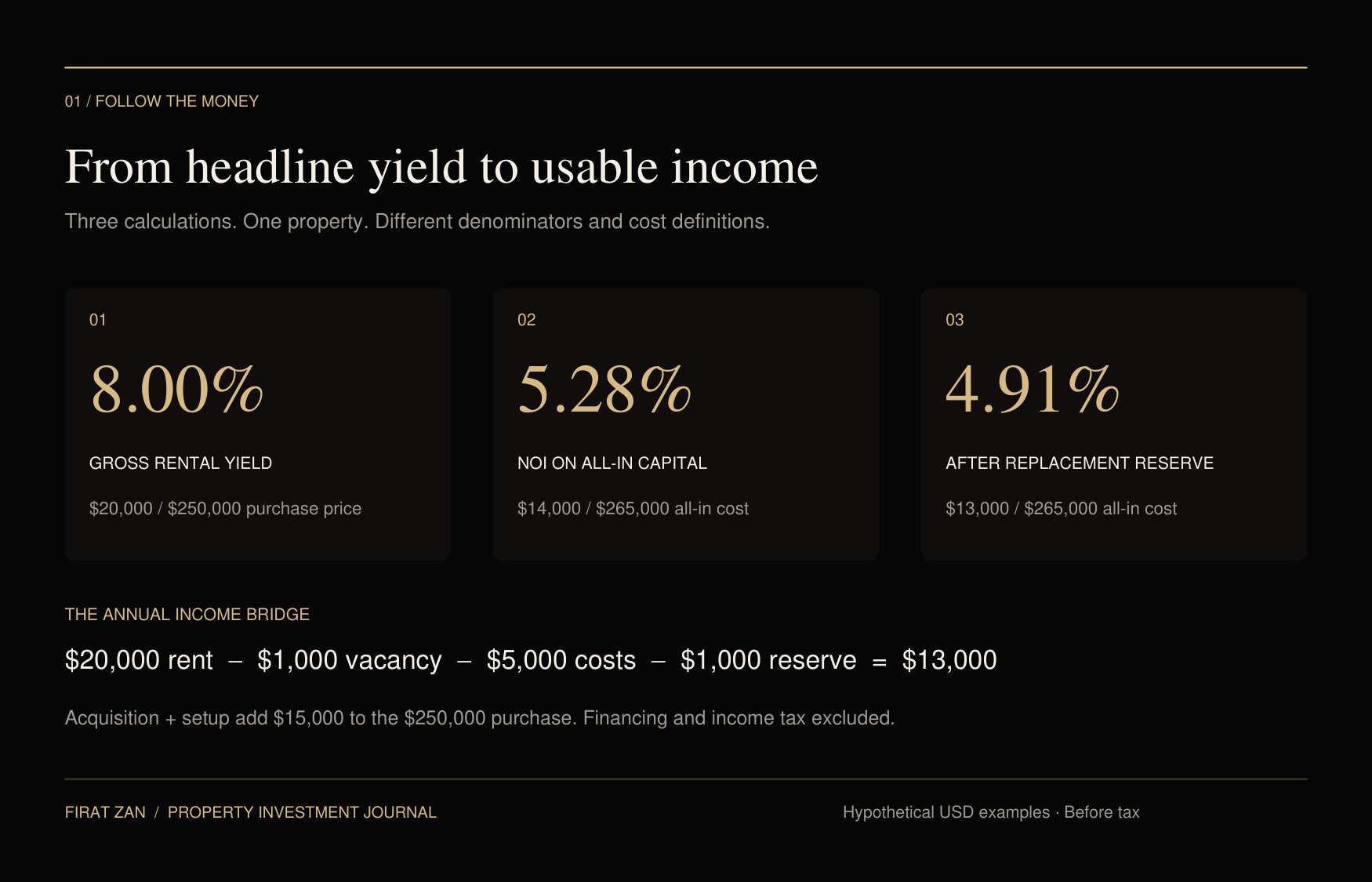
In the illustrative example below, a $250,000 purchase requires a further $15,000 for acquisition and setup. Total invested capital is therefore $265,000. Even before operating costs, $20,000 of scheduled rent represents about 7.55% of that amount, rather than 8%. These figures are hypothetical, not a quote for any specific market.
3. Move from scheduled rent to collected rent
A rental contract and a rental forecast are different kinds of evidence. A forecast can assume twelve occupied months, but a property may have a gap between tenants, a delayed first lease or unpaid rent. A model should reflect income that can reasonably be collected rather than the maximum income that could be advertised.
Suppose the $20,000 scheduled annual rent is reduced by a $1,000 allowance for vacancy and collection losses. Effective rental income becomes $19,000. The $1,000 assumption is a planning input equivalent to 5% of scheduled rent; it is not a universal vacancy rate and should be replaced with property-specific evidence.
Keep different sources of income separate. Parking, storage or other charges may contribute, but refundable tenant deposits are not rental profit. For short-term rentals, room revenue should be distinguished from platform commissions, cleaning charges and taxes collected on behalf of an authority. Otherwise the model can count money that does not belong to the owner.
4. Deduct the expenses the owner actually pays
Recurring ownership costs may include building service charges, property management, insurance, applicable property taxes, routine repairs, leasing costs and owner-paid utilities. The lease determines which expenses fall on the tenant, and local rules can change that allocation. Obtain actual documents and quotations rather than applying one convenient percentage to every property.
Major replacements deserve a separate reserve. Air-conditioning systems, appliances and furnishing do not last indefinitely. A reserve is a budgeting allowance rather than proof that the same expense occurs every year. Keep the distinction clear when reporting net operating income: capital replacements and financing generally sit outside conventional NOI.
For the example, annual operating expenses are $5,000. Effective rent of $19,000 minus these expenses gives $14,000 of NOI before financing and income tax. A further $1,000 annual capital replacement reserve leaves $13,000 available before financing and tax on a reserve-adjusted basis. Define the measure instead of simply calling every number “net yield.”
5. An 8% headline can become a 4.91% reserve-adjusted yield
The example now has three different income yields. Gross yield on the purchase price is 8%. NOI yield on all-in acquisition cost is approximately 5.28%, calculated as $14,000 divided by $265,000. Reserve-adjusted income yield on the same capital is approximately 4.91%, calculated as $13,000 divided by $265,000.
None of these figures is a prediction. They demonstrate how the same property can look different when the calculation becomes more complete. The reserve-adjusted result is before financing and investor-level tax; it does not include price appreciation, selling costs or currency changes.
This is also why comparisons require consistent definitions. Comparing one property's gross yield with another property's reserve-adjusted yield rewards whichever listing omits more costs. Put both properties through the same model, use the same time period and distinguish verified figures from estimates.
| Purchase price | $250,000 |
| Acquisition and setup | $15,000 |
| Total invested capital | $265,000 |
| Scheduled annual rent | $20,000 |
| Vacancy / collection allowance | −$1,000 |
| Operating expenses | −$5,000 |
| Net operating income (NOI) | $14,000 |
| Capital replacement reserve | −$1,000 |
| Reserve-adjusted income | $13,000 |
| Gross yield on purchase price | 8.00% |
| NOI / all-in cost | 5.28% |
| Reserve-adjusted income / all-in cost | 4.91% |
Illustrative annual model in USD. Before financing and income tax. The reserve-adjusted measure is not conventional NOI.
6. Cash flow after debt service is a different result
Debt changes what reaches the investor's bank account. NOI describes property operations before financing. Cash flow after debt service subtracts interest and principal payments, then any capital spending or reserve contribution included in the model. A property can have positive NOI while producing little or negative distributable cash.
Assume the example property is financed with a $150,000 loan. Initial investor cash is $115,000, comprising the $100,000 price contribution plus $15,000 acquisition and setup costs. If annual debt service is $10,000, the $13,000 reserve-adjusted income leaves $3,000 before tax. Cash-on-cash return is approximately 2.61%: $3,000 divided by $115,000.
Debt service includes principal repayment, which reduces the outstanding loan and builds equity; it is not entirely an economic expense. Interest is a financing cost. Keep both components visible so that cash flow and wealth creation are not confused. A low cash-on-cash return may coexist with principal reduction, but that does not make the cash-flow constraint disappear.
7. Total return includes changes in value
Income yield measures one part of an investment. Total return also considers gains or losses in property value, together with relevant costs. A rent-producing asset can still lose money overall if its value falls sufficiently. Equally, an asset with modest income can produce a positive total result if its value rises and the gain survives transaction costs.
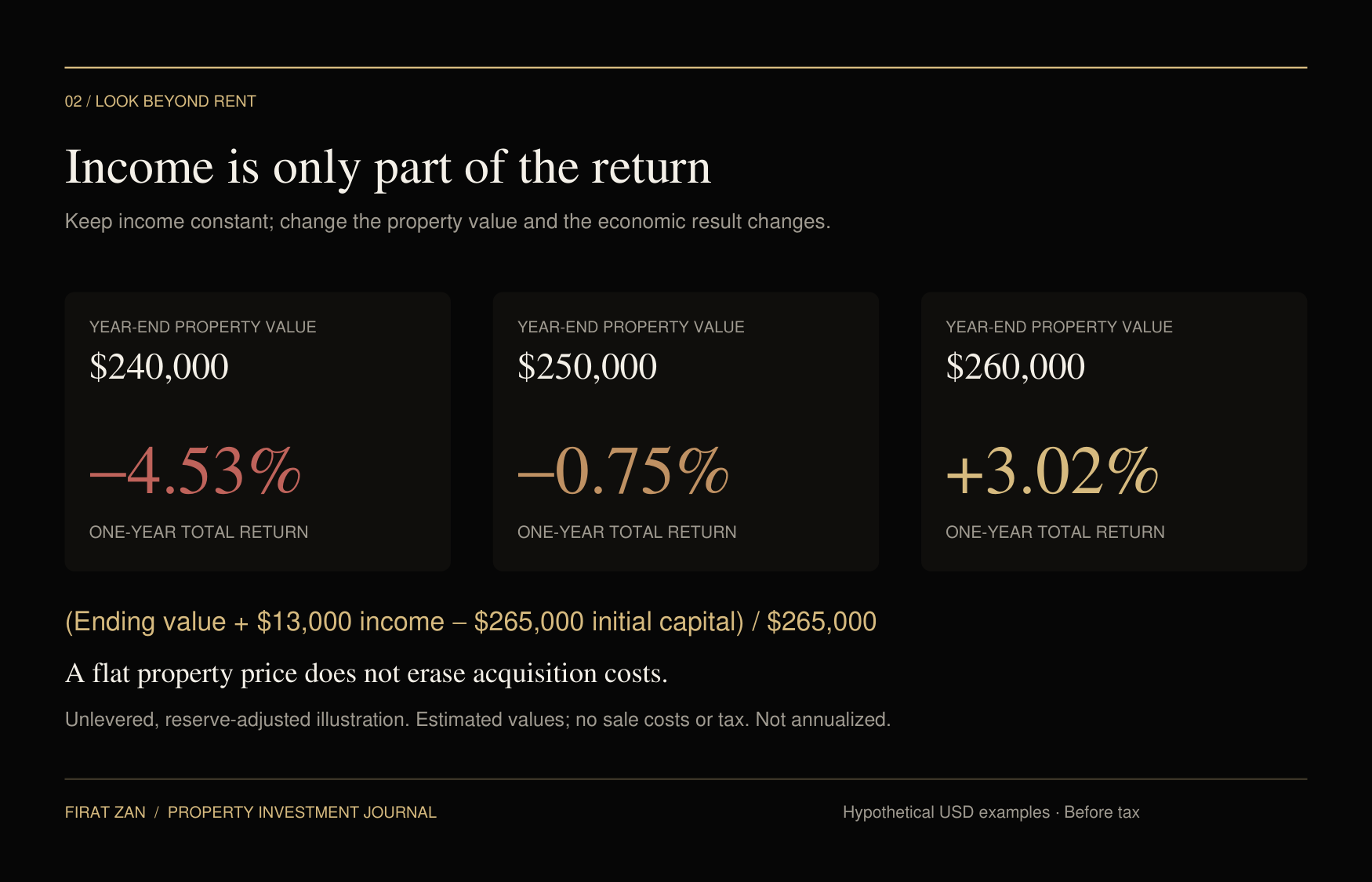
For a simple unlevered illustration, hold the $265,000 all-in starting cost and $13,000 reserve-adjusted income constant. Assume no sale costs and no tax. If year-end property value is $250,000, ending value plus income is $263,000, which is $2,000 below initial capital: approximately -0.75%. Acquisition costs explain why flat property value does not mean a positive first-year total return.
If year-end value is $260,000, the equivalent result is approximately 3.02%. If it falls to $240,000, the result is approximately -4.53%. These mark-to-market illustrations use an estimated value, not realized sale proceeds. A real exit must deduct selling costs, and multi-year investments require attention to cash-flow timing.
8. Do not count principal repayment twice
Leverage can make a percentage return on equity look larger because the investor contributes less initial capital. It can also amplify losses. A fall in asset value is absorbed by the owner's equity while the loan remains payable. Financing therefore changes the risk as well as the denominator.
When calculating the investor's total equity result, begin with initial cash contributions, include actual cash distributions and end with the property value minus outstanding debt and exit costs. If principal has been repaid, that improvement is already reflected in the lower ending debt. Adding the same principal reduction again would overstate the return.
Extra contributions matter too. If the owner must inject cash for repairs or to cover a shortfall, the investment did not achieve the result without additional funding. For several years with irregular contributions and distributions, a dated cash-flow model and an appropriate return calculation provide more information than a single annual yield.
9. Stress-test vacancy, expenses and financing together
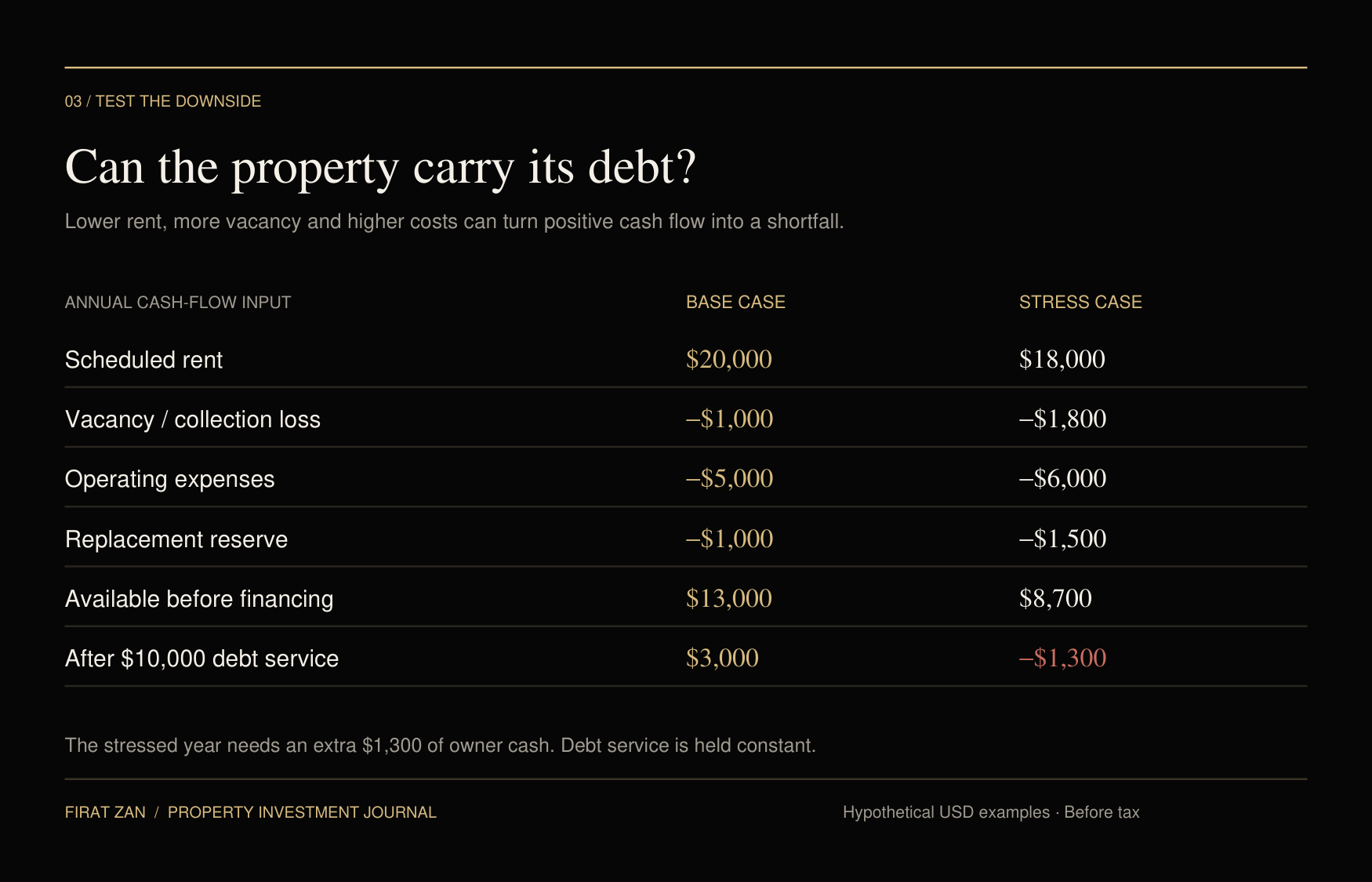
A base case is only one version of the future. Test an adverse operating year in which scheduled rent falls to $18,000, vacancy and collection losses increase to $1,800, operating expenses rise to $6,000 and the capital reserve increases to $1,500. Reserve-adjusted income then becomes $8,700.
On $265,000 invested without debt, that is approximately 3.28% before tax. With the earlier $10,000 debt service assumption, it becomes a $1,300 cash shortfall. The calculation shows how borrowing can turn a lower-income year into a need for additional cash.
Use a financing stress consistent with the actual loan. A fixed-rate payment does not immediately change because market rates rise, but refinancing terms may change at maturity. Floating-rate borrowing can respond sooner. Test lease expiry, loan maturity and major replacement dates together rather than treating each risk as an isolated event.
10. Cross-border investors need a second currency calculation
A property return quoted in local currency may differ from the return measured in the currency you use for spending or reporting. Purchase capital, rent, expenses, debt and sale proceeds can create different currency exposures. The same property can therefore generate different outcomes for two investors with different base currencies.
For a simplified one-period example, a 5% local-currency return combined with a 10% fall in that currency against the investor's base currency produces approximately -5.5% in base-currency terms: 1.05 multiplied by 0.90, minus one. This assumes a single end-period conversion and ignores costs. Rent received and converted throughout the year requires dated exchange rates.
Separate nominal return from purchasing-power return as well. Inflation, conversion costs and investor-level taxes can change what the proceeds buy. Keep local property performance visible, then show the currency and tax adjustments separately. This makes it easier to understand whether the result came from the asset or from an external factor.
11. Check the exit before you accept the entry yield
Property is not equally liquid across locations, buildings or price bands. A high projected rent does not establish that a buyer will be available when you want to sell. Consider who the likely exit buyer is, how comparable units have traded and whether financing is accessible to that buyer.
Include likely selling costs and a realistic marketing period. If the property is vacant during a sale, the exit process may reduce rental income as well as create costs. An outstanding loan can also involve settlement charges depending on its terms. A sale-price estimate is not the same as net cash released.
Off-plan investments need another timeline. A promised stabilized rental yield after completion does not describe the return earned while payments are being made and no rent is collected. Compare purchase installments, handover costs and a plausible leasing period. A delivery delay changes the timing of the return even if the eventual rent is unchanged.
12. A practical property investment checklist
Before comparing opportunities, assemble the acquisition budget, signed or evidenced rent, expense documents, reserve assumptions, financing schedule and exit estimate. Mark each input as verified, quoted or assumed. This prevents an attractive spreadsheet from hiding a weak evidence base.
Ask six questions: What is the all-in capital requirement? What rent is realistically collectible? Which costs remain with the owner? What cash is available after financing and reserves? How does the result change in an adverse year? What would be left after a realistic sale? For cross-border ownership, add the base-currency and local tax checks.
The most useful investment number is the one whose definition matches the decision. Gross yield helps with an initial screen. NOI helps assess property operations. Cash-on-cash return helps assess cash distributed against initial equity. Total return helps assess the broader economic outcome. Use the measures together, and keep their limitations visible.
Frequently asked questions
Is net rental yield the same as total return? No. Income yield describes rental earnings under a specified cost definition. Total return also considers gains or losses in value and the relevant cash flows and costs.
Does mortgage principal count as a cost? It reduces spendable cash, but it also reduces debt. Separate it from interest and avoid counting the equity improvement twice.
Are these figures Dubai or Turkey market estimates? No. They are hypothetical USD examples. Replace each assumption with current local documents, quotations and the terms of the actual property and loan.
This article is educational investment commentary. All numerical examples are hypothetical; local taxes, financing terms and transaction rules require property-specific checks.